But that truth is impossible to ignore.
When we talk about teaching being political, we are not talking about party lines, elections, or political campaigns. We are talking about values. We are talking about power, justice, responsibility, and the kind of society we are preparing children to live in—and eventually lead.
Every day, teachers make decisions that shape how children understand the world.
Do we encourage cooperation or competition?
Do we value obedience or critical thinking?
Do we address injustice, or do we ignore it?
Do we teach children to speak up, or to stay quiet and comply?
These are not neutral choices. They reflect beliefs about people, society, and what it means to be a good human being. And those beliefs influence the kind of adults our students will become.
Montessori Was Never Meant to Be Neutral
Maria Montessori did not create a method solely for teaching reading and math. She envisioned education as the foundation for peace and social change. Her work was deeply connected to ideas of human dignity, freedom, responsibility, and global citizenship.
The Montessori classroom is not just a place where children memorize facts. It is a small community.
In it, children:
- Practice freedom within limits
- Resolve conflict through conversation and empathy
- Work in mixed-age communities that reflect the real world
- Study the histories and cultures of people across the globe
- Learn that their actions affect others
These are not simply academic exercises. They are lessons in how to live together as human beings. That is inherently political, because it speaks directly to how societies function.
Montessori believed that education was the path to peace. Not peace as a slogan, but peace as a daily practice—built through respect, independence, responsibility, and understanding. That vision places education at the heart of social and political life.
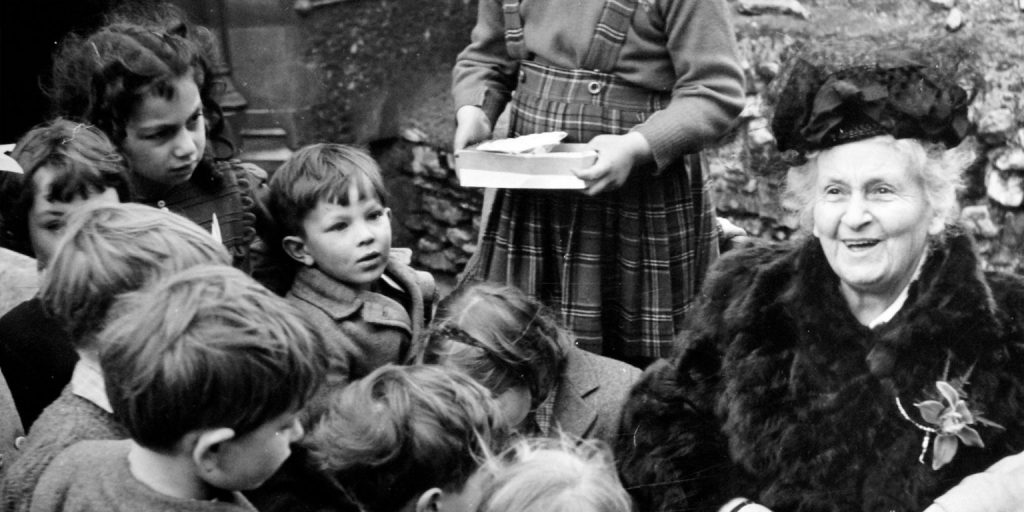
She wrote:
“Establishing lasting peace is the work of education; all politics can do is keep us out of war.”
And also:
“The child is both a hope and a promise for mankind.”
These were not poetic slogans. They were the foundation of her life’s work.
When Montessori Refused to Bow to Fascism
Montessori’s beliefs were not just theoretical. She lived them—even when it came at a personal cost.
During the rise of fascism in Italy, Benito Mussolini initially supported Montessori schools because he saw them as a way to strengthen the nation’s image. For a time, Montessori education spread widely across Italy with state backing.
But the relationship did not last.
Mussolini eventually demanded that Montessori schools become instruments of the fascist regime. He expected them to promote authoritarian ideals, nationalist propaganda, and unquestioning loyalty to the state. This stood in direct opposition to Montessori’s core principles of freedom, independence, and respect for the child.
Montessori refused.
She would not allow her name, her schools, or her method to be used as tools of political indoctrination. As a result, the fascist government shut down Montessori schools in Italy. Montessori was forced into exile, spending much of the war years away from her homeland, including time in Spain, the Netherlands, and later India.
Her exile was not the result of party politics. It was the result of standing firm in her belief that education must protect the dignity and freedom of the child. She would not compromise those principles, even under pressure from a dictator.
This moment in history is a powerful reminder: Montessori education was never meant to be neutral or submissive to authority. It was designed to protect the child from exactly that kind of system.
She once wrote:
“An education capable of saving humanity is no small undertaking; it involves the spiritual development of man.”
Why Children Deserve the Truth
One of the most important responsibilities of a teacher is to speak truthfully to children about the world they live in.
Children are not oblivious. They hear conversations at home. They see news headlines. They absorb the tension, fear, and confusion around them. When adults pretend nothing is happening, children are left to process these things alone.
Speaking truthfully does not mean overwhelming them with frightening details. It means offering honest, age-appropriate explanations and creating a safe space for questions.
Montessori believed deeply in the child’s ability to understand the world when guided with respect. She wrote:
“The child who has felt a strong love for his surroundings and for all living creatures, who has discovered joy and enthusiasm in work, gives us reason to hope that humanity can develop in a new direction.”
When we talk about current events with children—carefully, respectfully, and truthfully—we are helping them develop that love, that understanding, and that hope.
A Responsibility, Not a Choice
Every day, I see children bring the world into the classroom with them. They talk about things they hear at home, things they see online, things that confuse or worry them. They don’t ask for political speeches. They ask simple, honest questions:
Why is that happening?
Is that fair?
What can we do?
In those moments, I am not just a teacher of grammar or fractions. I am a guide helping them make sense of the human world. And that responsibility is, whether we like it or not, deeply political.
Whether we acknowledge it or not, teaching shapes the future of society. Every interaction, every lesson, every conversation sends a message about what matters and how people should treat one another.
In Montessori, we do not just prepare children for tests. We prepare them for life.
And life is not neutral. It is complex, diverse, and deeply interconnected. To pretend otherwise is to do children a disservice.
Teaching is inherently political because it is about people, values, and the world we are trying to build together. In Montessori, that world is one rooted in peace, respect, truth, and responsibility.
And that is something worth talking about—honestly, and with children included in the conversation.
 Confessions of a Montessori Teacher
Leave a comment